From Marine Engineering to Systems Biology
A structural FMEA approach to complex chronic pathophysiology.
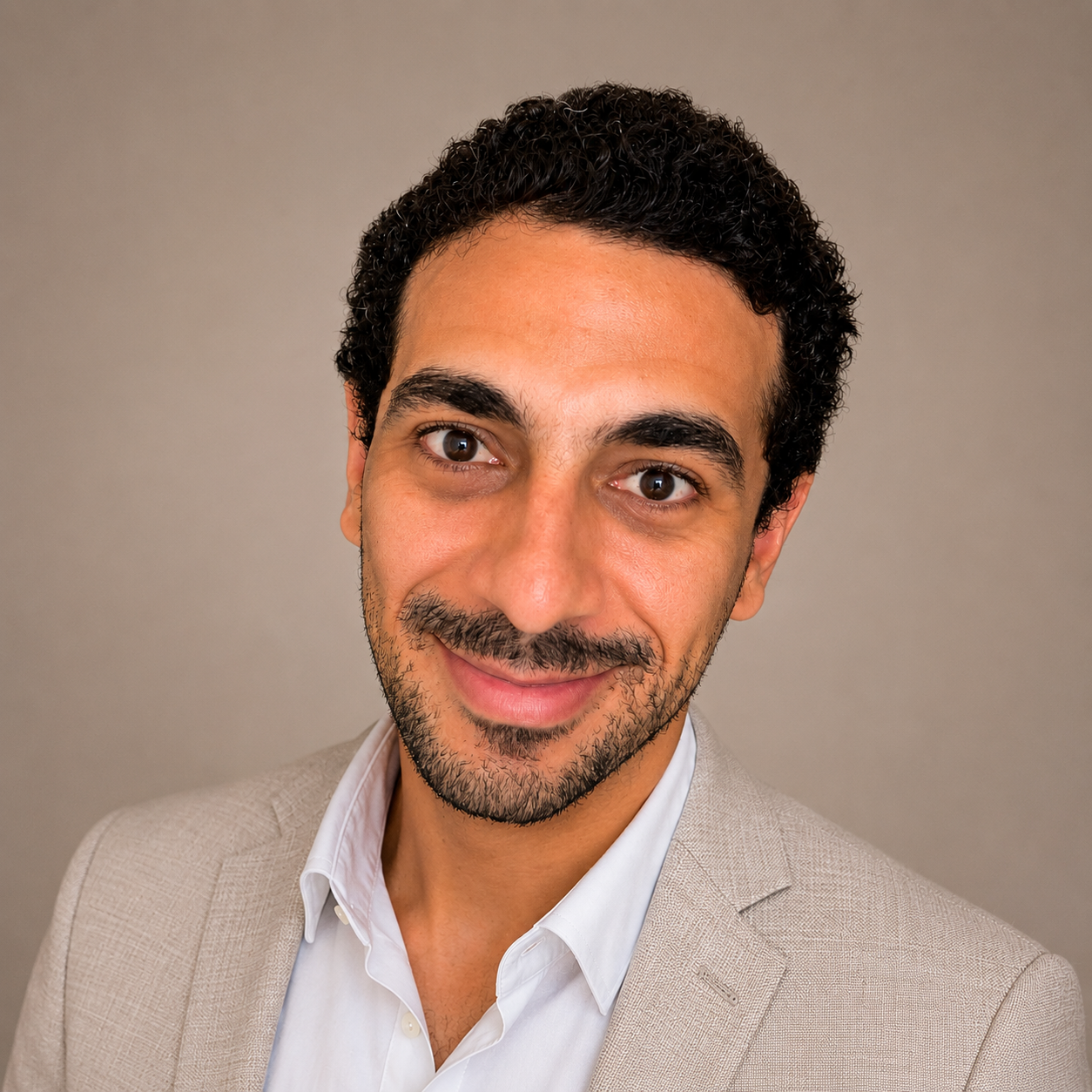
I am Mohammed Attallah, an independent systems biology consultant and mechanistic analyst, and developer of the Host Capacity Model — a proposed, independently developed systems-biology framework that has not been clinically validated and does not reflect medical consensus.
My work bridges thermodynamic fluid dynamics, immunometabolism, organelle biophysics, and host-microbe ecology. I founded BiomeLogic because complex, multi-system chronic conditions — including recurrent SIBO, Mast Cell Activation Syndrome (MCAS), post-viral syndromes such as Long COVID, hypermobile Ehlers-Danlos Syndrome (hEDS), and refractory dysmotility — can be difficult to capture within a single-system, single-specialty frame.
From Alexandria to systems architecture
My background is in structural systems engineering, not medicine, and that background shapes how I approach complex, multi-system cases.
I was born and raised in Egypt, and my academic background included marine-engineering study in Alexandria — analyzing, modeling, and troubleshooting large closed and semi-closed thermodynamic systems under severe environmental stress. That study centered on fluid dynamics, energy conversion kinetics, boundary-layer mechanics, stress corrosion cracking, and Systemic Failure-Mode and Effects Analysis (FMEA). No degree, license, or institutional affiliation is claimed here, and none is implied by the work below.
After moving to the United States, my analytical focus shifted from mechanical and naval structures to a far more intricate dynamic architecture: the human organism.
What I discovered was striking. The human gastrointestinal, vascular, and neuro-immune networks obey the same physical and thermodynamic laws that govern complex engineering systems:
| Marine engineering & naval architecture | Human systems biology & pathophysiology |
|---|---|
| Hull stress corrosion cracking | Extracellular matrix degradation — enzymatic breakdown of collagen scaffolding and tight-junction networks in hypermobile (hEDS) and MCAS patients. |
| Cavitation & boundary-layer failure | Enteric motor collapse & lymphatic stasis — hydrodynamic pump failure mirrors submucosal edema, interstitial stagnation, and Migrating Motor Complex (MMC) paralysis. |
| Engine block bioenergetic failure | Colonocyte respirasome disassembly — mitochondrial electron-transport-chain uncoupling, NAD⁺ exhaustion, and colonocyte bioenergetic collapse. |
| Thermodynamic energy conversion | Mitochondrial OXPHOS & colonocyte β-oxidation. |
| Boundary-layer & hydrodynamics | Mucosal layer rheology & lymphatic clearance. |
| Material degradation & structural fatigue | Extracellular matrix breakdown & tight-junction cleavage. |
| Closed-loop fluid flow / cavitation | Microvascular ischemia & enteric motor impairment. |
| Systemic Failure-Mode & Effects Analysis | Upstream mechanistic case reconstruction. |
An engineering lens treats these systems as interconnected — one way of framing findings that might otherwise be evaluated separately across different organs and specialties.
The Host Capacity Model: flipping the microbiome paradigm
This engineering background led directly to the development of the Host Capacity Model.
One common clinical approach to recurrent SIBO or dysbiosis is to identify an overgrowth and target it with antimicrobials. The Host Capacity Model — a proposed, unvalidated hypothesis, not an established finding — explores a different possibility: that in some recurrent cases, microbial shifts may be an ecological adaptation to an upstream host substrate failure rather than the primary cause of pathology.
Framed as an engineering question: What structural or bioenergetic parameters of the microenvironment failed, forcing the ecosystem to adapt?
When host colonocytes lose their bioenergetic capacity to perform β-oxidation — driven by NAD⁺ depletion, SIRT3 deactivation, and mitochondrial oxidative stress — the consequences have measurable physiological correlates:
- Oxygen gradient collapse. The mucosal lining loses its physiological hypoxia (pO₂ < 10 mmHg, or < 1%), allowing atmospheric oxygen to leak into the lumen.
- Ecological succession. Facultative anaerobes such as Enterobacteriaceae can expand by utilizing host-derived electron sinks (nitrate and oxygen), displacing obligate anaerobic butyrate producers.
- Macromolecular rheology collapse. Pathobiont enzymes cleave terminal sugars from MUC2 mucin glycans, which can cause a steric and electrostatic surface-charge collapse that degrades the protective mucin hydrogel matrix into an un-entangled polymer solution.
Read as a hypothesis rather than a settled finding: in this framing the microbes are less usefully described as "invading" than as occupying an ecological niche the host may no longer have the thermodynamic capacity to defend. Whether that holds in any individual case is a case-specific inference, tracked in the framework audit and claim ledger.
Sub-cellular failure-modes: mapping the systemic locks
The Host Capacity Model proposes that when host capacity drops below a critical threshold, biochemical feedback loops can hold a system away from self-repair. The candidate molecular locks below are proposed mechanisms drawn from published biochemistry, not case-wide established facts; their relevance to any individual case is an inference, not a finding:
- Glial Connexin-43 hemichannel purinergic leaking. Reactive enteric glial cells open large-pore Cx43 hemichannels, purging eATP and glutamate into the extraneuronal space, causing excitotoxic loss of nitrergic motor neurons and permanent MMC paralysis.
- The ACOD1 / itaconate trap. Translocated bacterial antigens activate macrophage ACOD1/IRG1, producing itaconate that competitively inhibits Succinate Dehydrogenase (Complex II), locking neighboring enterocytes in paracrine energy starvation.
- The iNOS nitrate electron sink. Inflammatory cytokine surges upregulate inducible Nitric Oxide Synthase (iNOS), producing nitrate (NO₃⁻) at the brush border — providing pathobionts with the exact terminal electron acceptor needed to maintain dominance.
- PDH S-nitrosylation lock. Excess nitric oxide directly S-nitrosylates Pyruvate Dehydrogenase (PDH), blocking Acetyl-CoA synthesis and freezing the TCA cycle regardless of caloric intake.
- PAR-2 & MMP-9 matrix degradation. Mast cell tryptase cleaves Protease-Activated Receptor-2 (PAR-2), activating matrix metalloproteinases (MMP-9) that dissolve the structural collagen matrix supporting the enteric nervous system.
Independent mechanistic analysis: the role of BiomeLogic
BiomeLogic operates outside the clinical delivery model. I am not a clinician; I work as an independent systems analyst and pattern-recognition specialist.
Complex, multi-system presentations — for example post-viral dysautonomia, mast cell instability, and chronic intestinal dysmotility together — are often managed across several specialists, each addressing their own domain. My role is to look across that history for a unifying mechanistic pattern, alongside, not instead of, a client's existing licensed care.
My aim is to reconstruct a plausible causal chain:
- Complete systemic reconstruction. I evaluate a client’s history, symptom chronology, lab testing, genetic proxies, and failed interventions as a single, integrated engineering schematic.
- Failure-mode mapping. I isolate the exact bioenergetic, structural, or neuro-immune locks that prevent host recovery.
- Detailed written reports. I generate detailed mechanistic reports, with reasoning and references made explicit, intended to be shared with and reviewed by the client's licensed medical team.
Evidence and uncertainty
The Host Capacity Model is an independently developed, proposed framework. It has not undergone formal external peer review, has not been clinically validated, and does not reflect medical consensus. Where a claim rests on established biochemistry versus case-specific inference, the distinction is stated explicitly in the accompanying framework audit, not blended into a single narrative.
This analysis is intended to help a client and their licensed clinicians consider additional mechanistic possibilities. It is not a diagnosis, and it does not guarantee any outcome.
Mohammed Attallah
Founder & Mechanistic Analyst, BiomeLogic
Bowie, Maryland, USA
BiomeLogic is not clinical care. Mohammed is not a licensed clinician and does not diagnose, treat, or prescribe. See the scope of practice.
- Educational systems-biology consulting · Not diagnosis
- Not diagnosis or treatment
- Works alongside your licensed care team
- Written mechanistic summary
- Fictional sample report available
- No files required for Gate 1
Hard Questions
For full provenance, see the Framework Audit, Counterargument Library, and Claim Ledger.